September 22, 2026
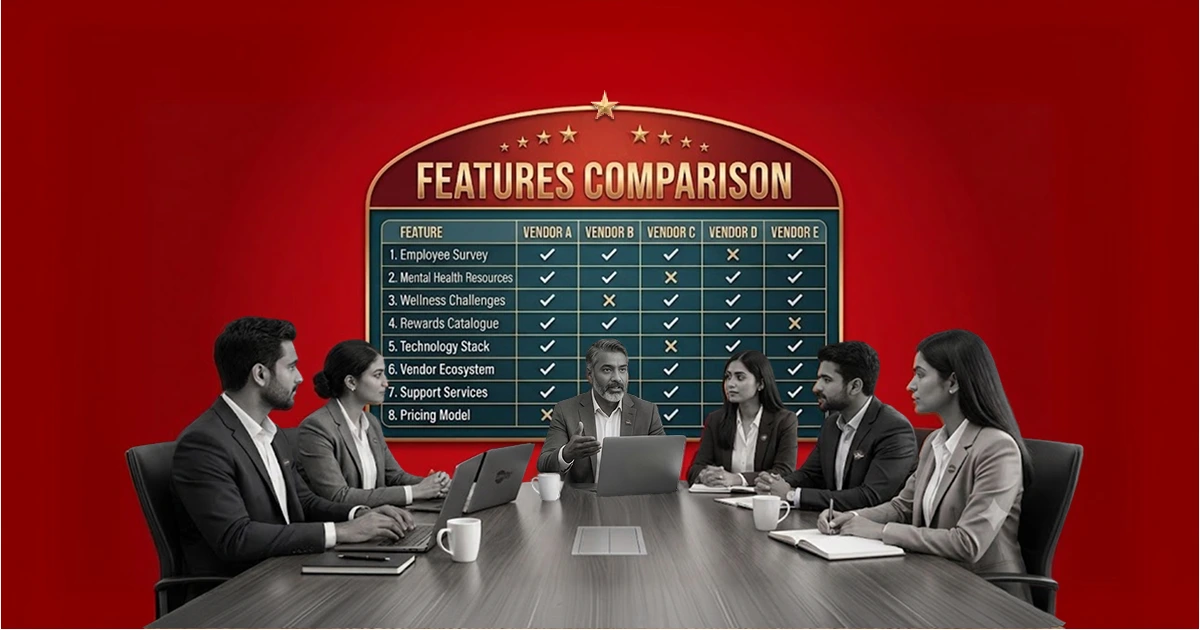
Table of Contents
h2
Example H2
This is a div block with a Webflow interaction that will be triggered when the heading is in the view.
Introduction
Six vendors. Six decks. Six recognition feeds that looks the same with different logos.
Buying an employee engagement platform in 2026 can quickly become an exercise in confusion. By demo four, most buying committees have stopped evaluating and started guessing. Not because the team is careless, but because feature lists are designed to look identical, and nobody hands you a method for telling the difference.
Here is the part worth knowing before you sit through another call. In our analysis of 1,000+ organisations, the highest performers and the middling performers were spending almost exactly the same money: 7.82 versus 7.49 on our engagement investment index. The Leaders got roughly 48% better business outcomes anyway.
The gap was not budget. It was the strategy. It was whether they built infrastructure or assembled point solutions.
This guide is that process: the sequence of decisions that separates a purchase you can defend a year later from one you spend that year explaining.
What Is an Employee Engagement Platform and Why Does It Matter - Before You Buy?
An employee engagement platform is the operating system where employee surveys, rewards and recognition, wellness, communication, and analytics run as one unified experience; connecting every employee engagement initiative to measurable business outcomes like retention, productivity, revenue peremployee, and eNPS.
It's the layer employees actually touch daily, designed to eliminate vendor sprawl and unify fragmented engagement data into actionable intelligence.
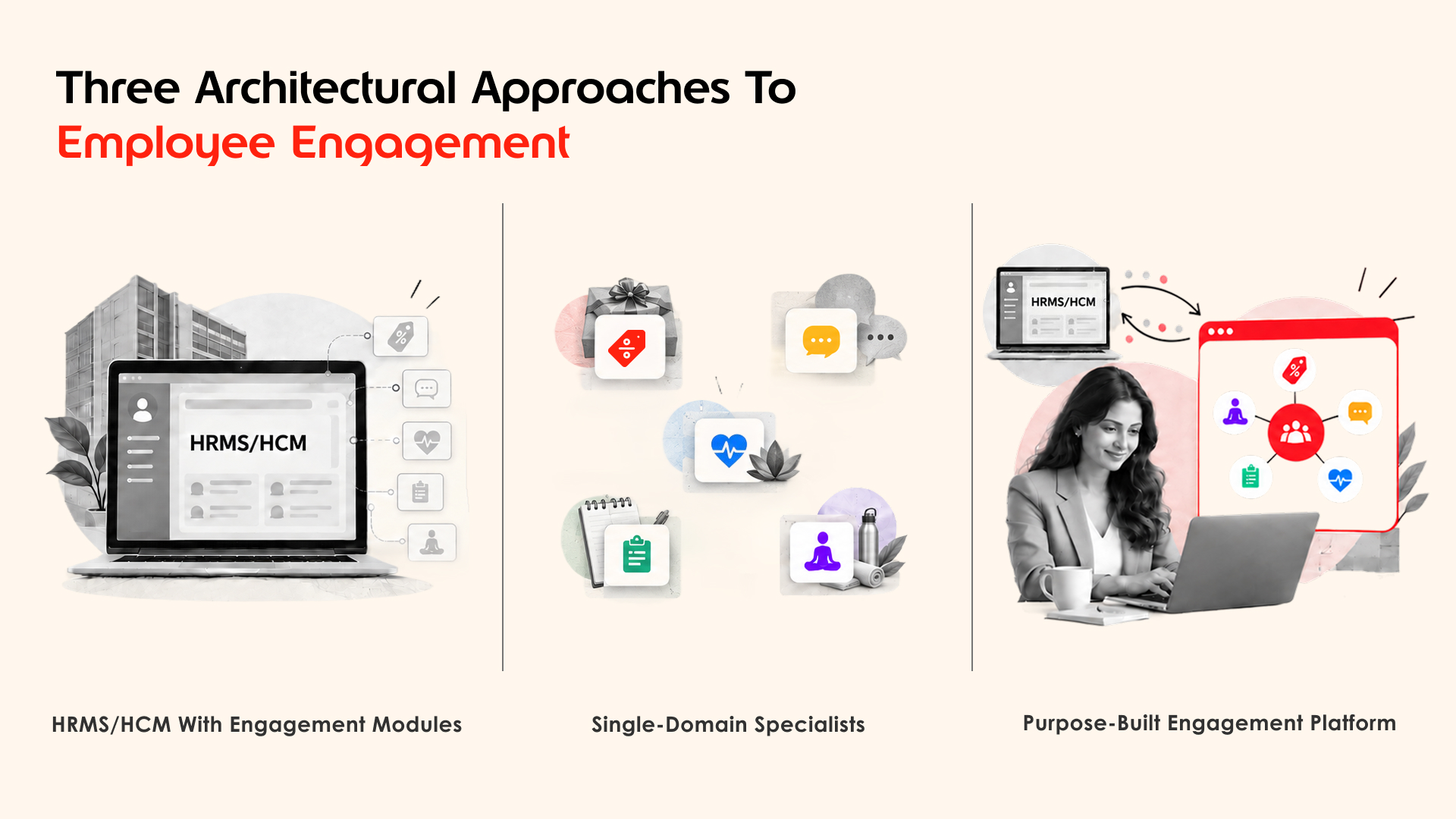
How you build that experience matters: The market offers three fundamentally different architectural approaches - some bolt engagement onto HRMS platforms, others specialize in single domains of the entire engagement gamut, and some build engagement as the core product.
Your choice of architecture determines whether engagement becomes strategic infrastructure or remains a collection of disconnected programs.
Start With the Business Problem Before Buying an Employee Engagement Platform
The most common mistake in this category is defining functionality before defining the outcome. It shows up as a requirements document full of features and empty of purpose, which is exactly the document a vendor most enjoys receiving.
Try this test instead. Write your business case as one sentence, in this shape:
We are losing [specific, measurable thing]in [specific population], and we believe the cause is [missing capabilities], whichwe know will be fixed with [specific mechanism].
Engagement-Specific Examples
Retention Problem
We are losing 34% of frontline supervisors within 18 months, and we believe the cause is invisible effort, and financial stress from rising living costs, which will be fixed with peer-to-peer recognition, manager-led awards,milestone celebrations, employee savings programs reducing daily expenses, pulse surveys surfacing early warning signs, and analytics connecting recognition frequency and financial wellbeing to retention risk.
Employee Advocacy Problem
We are losing eNPS by -12 points in sales, because we do not have continuous feedback, clear growth visibility, or purchasing power support, and we believe pulse surveys, performance-tied recognition, employee discounts, closed-loop communications, and sentiment analytics will change it.
Productivity Problem
Revenue per employee in our service delivery teams is 15% below industry benchmark, and we believe the cause is burn-outs, absenteeism and lack of belonging, which will be fixed with recognition for milestones, habit building wellness challenges, preventive healthcare like annual health checks, Employee assistance programs etc.
Two Things Happen When You Write This Sentence
- Finance stops treating the purchase as an HR nice-to-have, because you have handed them a number they need.
- Every vendor conversation gets an anchor, because you can now ask each one to explain their mechanism against your specific problem rather than performing a general tour.
Now that you have your business case defined, you can evaluate which architectural approach solves your specific problem.
Three Architectural Approaches to Employee Engagement
The HR technology market offers three primary architectural approaches to employee engagement, each optimized for different organizational priorities. The right architecture often matters more than features when buying an employee engagement platform.
[1] HRMS/HCM Platforms With Engagement Modules Bolted-On
Vendors build solid core infrastructure for payroll or compensation, or compliance, etc. but engagement features like surveys, recognition, wellness often lags in depth and capabilities. You get unified data and vendor simplicity, but engagement capabilities are afterthoughts rather than strategic priorities.
[2] Single-Domain Engagement Specialists
Vendors offer best-in-class depth in one area of employee engagement. To cover the full spectrum like listening, recognition, rewards, wellness, communication, requires assembling 3-5 vendors, creating integration complexity, data fragmentation across systems, and a disjointed employee experience with multiple logins and interfaces.
[3] Purpose-Built Employee Engagement Platforms With Native HRMS/HCM/HRIS Integrations⭐
Vendors treat engagement as the core product rather than a bolt-on. These platforms cover the full engagement spectrum right from employee surveys, R&R and wellness to communication and engagement specific analytics - in a unified experience, while integrating deeply with your existing HRMS for employee data. This essentially deliver full capabilities across all domains without compromise.
Built specifically for organizations where engagement drives measurable business outcomes (retention, productivity, revenue per employee), particularly those with complex workforce structures: multi-geography operations, large frontline or deskless populations, and limited IT resources for managing multiple vendor integrations.
The Pattern Across Industries
The question isn't which path is "valid" - all three exist in the market. The question is which trade-offs align with your priorities.
For most organizations reading this guide - where engagement is a strategic priority, not a compliance checkbox - Path 3 delivers the best balance of capability, simplicity, and measurable outcomes.
Who Needs to Be in the Room Before You Talk to Any Vendor
Deals in this category rarely die in the demo. They die in month four, when someone who was never consulted asks a question nobody prepared for.
Assemble the full committee first and write down the questions each person will eventually ask.
That last row is the one most committees skip, and it is the one that decides adoption in Indian enterprises with large deskless populations.
Get every one of these people to sign off on the requirements document. Not the shortlist. The requirements.
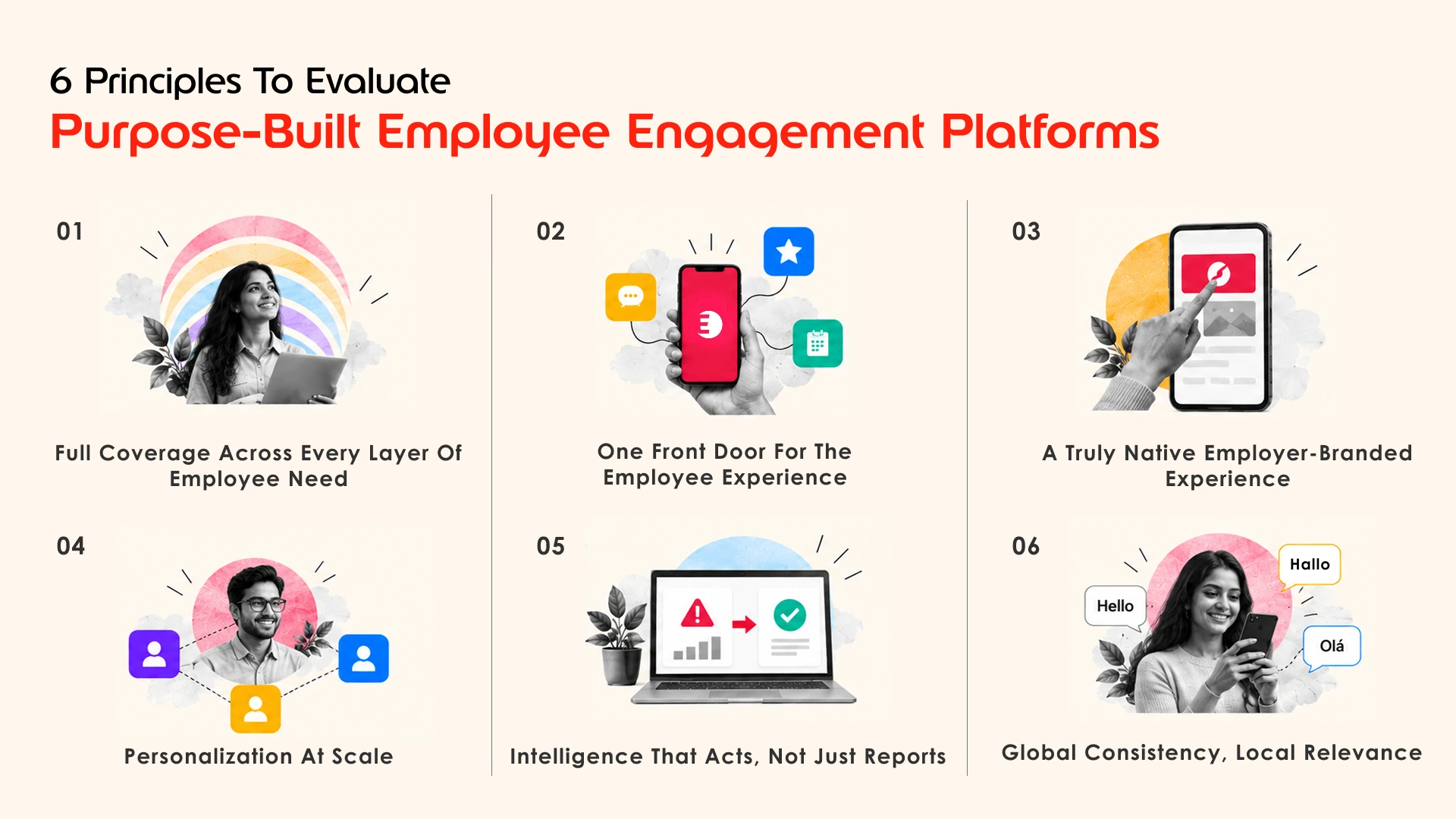
6 Principles to Evaluate Purpose-Built Employee Engagement Platforms
Most vendors will show you the same feature list: surveys, recognition, rewards, analytics. The difference is not what they have built, but how they built it.
A true engagement platform is infrastructure, not a collection of programs. That architecture determines whether the system scales, whether data is trustworthy, and whether your team spends their time running programs or stitching tools together.
We have written separately about the six principles that separate infrastructure from programs. Here is the short version:
Must-Have Capabilities for an Employee Engagement Platform
Above mentioned 6 principles are the foundation. When they are done right, they enable the capabilities buyers actually use:
A vendor that is excellent at recognition and absent at listening is not a complete employee engagement platform, whatever the vendor website engagement suite page says. It is a point solution with ambitions. And a vendor that has all six capabilities but violates the principles - separate logins, disconnected data, overnight sync - has built six tools, not one platform. You will spend the next three years stitching them together.
Score each vendor on the principles first, then the capabilities. The principles determine whether the platform works as infrastructure. The capabilities determine whether it covers your functional needs.
Questions to Ask Before You Buy an Employee Engagement Platform
Demos are rehearsed. Your job is to move off the script within the first ten minutes, because everything before that point has been optimised over hundreds of calls and tells you nothing.
Send your must-have list in advance and ask for the demo to follow your order, not theirs. Then use these.
Questions About Data and Integration
- Show me the field mapping between your platform and our HRMS. Not a slide, the actual mapping interface.
- When an employee changes manager mid-cycle, what happens to their pending recognition, their survey assignment and their budget allocation?
- Which parts of the integration are configuration and which parts are custom development? Who pays for the second category?
- If we terminate, what data do we get back, in what format, and how long do we have to retrieve it?
- Does survey data ever leave the platform boundary for model training or benchmarking, and can we switch that off?
Questions About Adoption and Rollout
- Show me the login experience for an employee with no corporate email on a low-end Android device on a poor connection.
- What does a manager see on Monday morning? Walk me through their default view.
- Across your Indian enterprise clients, what does adoption look like at month three versus month twelve, and how do you define adoption?
- What happens when a department stops using it? Does the system notice, and does it tell anyone?
- Who from your team is on the ground during rollout, for how long, and is that included in the quoted price?
Questions About Measurement
- Show me a report a CHRO would take into a board meeting. Built live, from your demo data.
- Can I segment by location, department, tenure and employment type at the same time?
- What is the minimum group size before survey results are shown, and can we configure it?
- Can I get this data out into our own BI tool, and does that cost extra?
What Indian Buyers Need to Check That Global Guides Skip
Almost every buyer's guide in this category is written for a US or UK buyer, and the gaps show up expensively.
Data Protection Under the DPDP Act
Engagement platforms process personal data at volume, including sensitive wellbeing and survey responses. Ask where data is stored, who the processors and sub-processors are, what the consent and notice mechanics look like, and how deletion requests are handled. Ask for it in writing, and have your legal team read the answer. Do not accept a GDPR certificate as a substitute for an India-specific answer.
Redemption Rails That People Actually Use
A rewards catalogue that only settles to international cards is a rewards catalogue nobody in your Tier 2 plants will use. Check for UPI, direct bank transfer, and brands with genuine local presence rather than a global list with three relevant entries.
Frontline and Shift-Worker Access
No corporate email. Shared devices. Intermittent connectivity. Ask specifically how login, recognition and redemption work under all three conditions, and ask to see it rather than hear about it.
Regional Language Coverage
Not just interface translation. Ask whether surveys, recognition messages, communications and the reward catalogue are all localised, because vendors frequently translate the UI and leave the content in English.
Tax and Accounting Treatment of Rewards
Reward values have tax implications for both the employee and the employer, and the reconciliation burden lands on your payroll team. Ask how the platform reports reward issuance, what documentation it generates, and who has done this before with an Indian client of your size. Then let your tax advisor rule on the treatment. That is their call, not the vendor's and not this article's.
Multi-Entity Structures
Many Indian enterprises operate across several legal entities with different policies. Ask whether the platform can run different reward budgets, catalogues and approval workflows per entity without separate contracts.
How to Compare Employee Engagement Platform Pricing
Employee engagement platform pricing typically follows three common models: per employee per month, tiered plans grouped by feature set, and discounted annual commitments. Vendors rarely use the same one, which is the point.
Before you compare a single number, normalise the quotes:
- Feature scope: Are surveys, recognition, action planning, benchmarking and dashboards included, or sold as modules?
- Employee minimums: A low per-user rate with a high floor can cost more than a higher rate with none.
- Survey caps: Unlimited pulses, or a fixed number per year with overage pricing?
- Reporting depth: Basic summaries, or manager-level segmentation and trend analysis? The second is frequently a tier upgrade.
- Integration inclusions: Which connectors are standard, and which are a professional services line item?
- Support tier: Named customer success manager, or a shared inbox?
Build one spreadsheet with identical rows for every vendor and force each quote into it. Vendors will resist. That resistance is itself a datapoint.
The Costs That Sit Outside the Subscription Line
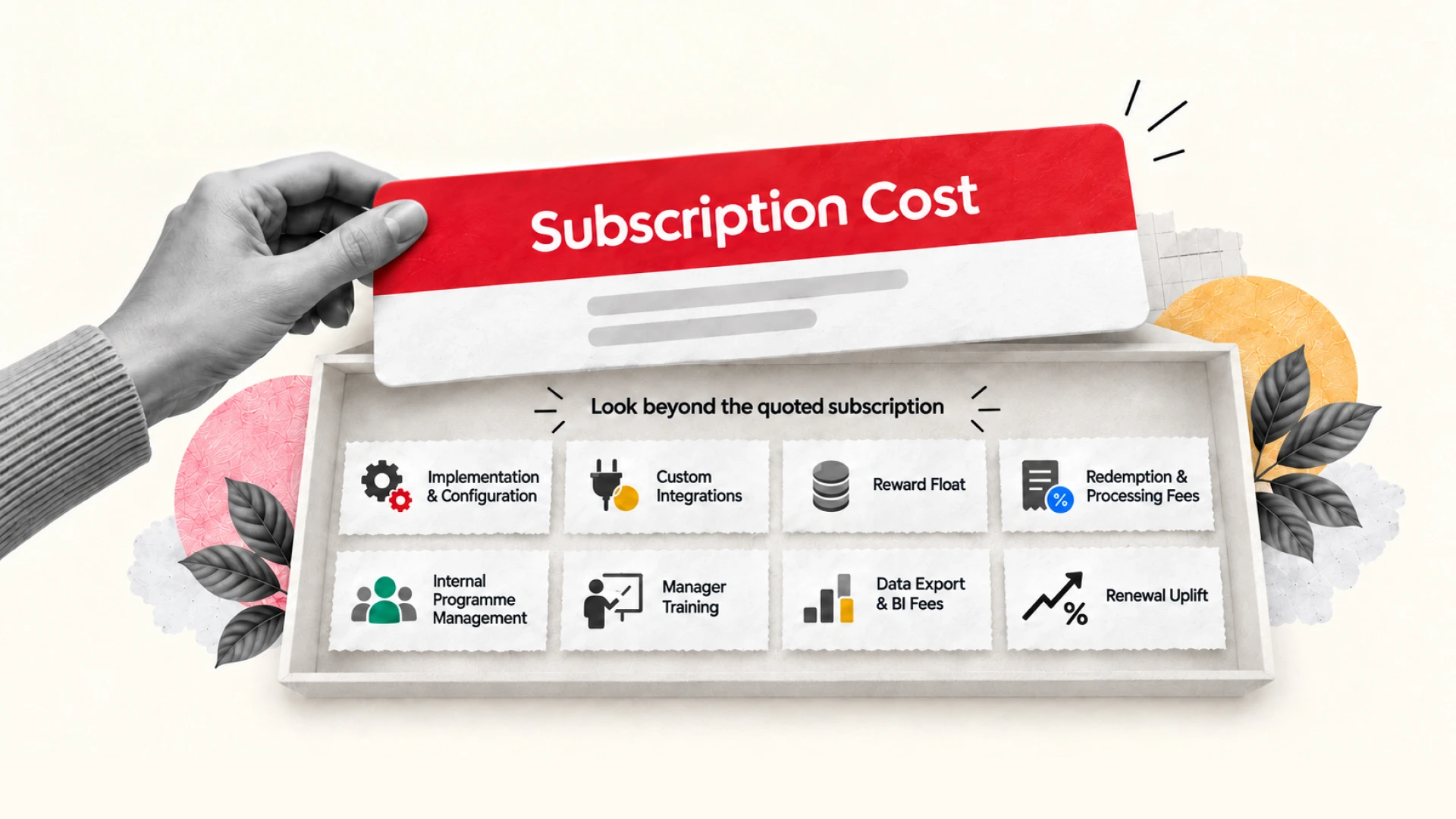
The subscription is rarely the whole number. Budget for these before you go to finance, because finding them later is how a well-run purchase acquires a reputation for being badly run.
- Implementation and configuration, often one-time and often negotiable
- Integration development for anything beyond the standard connector list
- The reward float itself, which for recognition programmes usually dwarfs the software cost
- Transaction, processing or catalogue margin on redemptions
- Internal programme management, the FTE time your team spends running this
- Manager enablement and training, especially if the platform expects manager-led action
- Data export or BI connector fees
- Renewal uplift, which is why you negotiate price protection now rather than in year two
Ask every vendor for a three-year total cost including modules and integrations. One number, one page.
Security and Compliance Checks Before Buying an Employee Engagement Platform
Start your employee engagement platform security review in week one. Not after you have picked a winner.
The pattern is predictable and avoidable. HR runs a six-week evaluation, picks a favourite, and hands it to IT security, who take four weeks and return a finding that cannot be remediated. Now HR has to restart or fight their own security team, and both options are bad.
Send the security questionnaire to all four shortlisted vendors at the same time you send the requirements. Cover certifications and their current validity, data residency, encryption at rest and in transit, sub-processor list, breach notification timelines, retention and deletion policy, access controls and audit logging, penetration test cadence, and survey confidentiality thresholds.
Specifically ask for evidence of security and compliance certifications rather than broad claims. Common standards buyers evaluate include:
- SOC 2 Type II for controls around security, availability, and confidentiality
- ISO 27001 for information security management practices
- GDPR readiness if employee data may be processed across jurisdictions
- DPDP Act readiness for organisations operating in India
Ask vendors to explain how these certifications apply to the actual product and services you will use, not simply provide a logo on a slide. Verify certification validity, audit scope, data residency practices, sub-processors, and how employee data can be exported or deleted upon request.
For Indian organisations, DPDP readiness deserves its own conversation. Ask how consent is managed, how deletion requests are handled, where employee data is stored, and what contractual commitments the vendor is willing to provide regarding data processing.
That last item is not just a compliance question. If employees believe survey responses can be traced back to them, your listening layer will produce polite, useless data forever.
A Practical Scorecard for Evaluating Employee Engagement Platforms
By this point the committee has opinions. A scorecard turns opinions into a decision anyone can defend.
Score each vendor 1 to 5 on each dimension, multiply by the weight, and total it. Adjust the weights to your context but agree on them before you see the scores.
Record the scores in writing with a one-line justification each. Twelve months from now, when someone asks why you chose what you chose, that document is the whole answer.
Contract Negotiation Tips When Buying an Employee Engagement Platform
Leverage is highest in the two weeks before signature and effectively zero after. Use it.
- Price Protection: Cap renewal increases for at least three years. Get it in the contract, not the email thread.
- Adoption-linked Terms: If adoption misses an agreed threshold by month six, what happens? A credit, a service commitment, an exit right. Vendors who believe in their product will engage with this.
- Module Expansion Pricing: Lock the price of the modules you might add in year two, while you are still a prospect rather than a captive customer.
- Data Portability and Exit: Format, timeline, cost and completeness of your data on termination. Get the field list.
- Implementation Scope in Writing: What is included, who does it, how long it takes, and what triggers a change order.
- SLA and Support: Response times, escalation path, named contact, and what happens when they miss.
- Pilot-to-Contract Crediting: If you ran a paid pilot, it should reduce year one.
How to Successfully Roll Out an Employee Engagement Platform in the First 90 Days
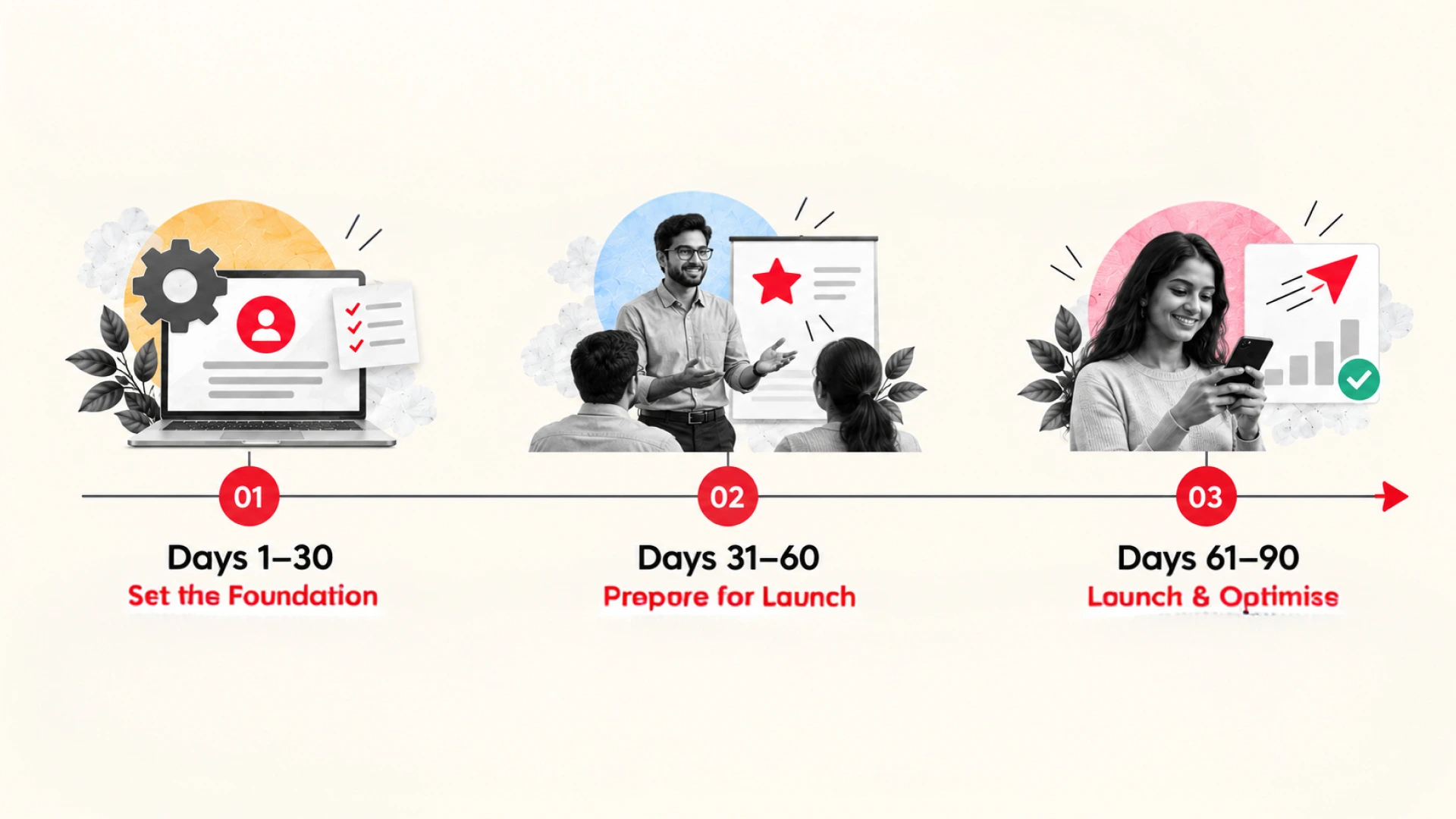
The purchase decision is roughly 30% of the outcome. The launch is most of the rest.
Days 1 to 30:
Complete the HRMS and identity integration before anything is visible to employees. Configure branding so the platform looks like your company rather than the vendor's. Set up segmentation rules by role, location and entity so people see only what applies to them.
Days 31 to 60:
Train managers before employees, always. Run manager sessions on the specific workflows they own, and make the first-week expectations explicit. Seed the recognition feed so day one is not an empty room. Establish the reporting cadence and who receives it.
Days 61 to 90:
Launch to employees with a communications plan that runs for weeks rather than a single announcement. Take your first measurement checkpoint at day 60. Identify the departments lagging and intervene while it is still a coaching conversation rather than a renewal problem.
Book the day-90 review before launch, with the same committee that made the decision in the room. Meetings that are not in the calendar do not happen.
Employee Engagement Platform Evaluation Checklist
Everything above, compressed into the list you can take into your next meeting:
✓ Business case written as one sentence with a measurable metric and a timeframe
✓ Finalise on the engagement solution architecture
✓ Full stakeholder committee assembled, including a frontline representative
✓ Requirements sorted into must-have, should-have and nice-to-have, with evidence standards attached
✓ Shortlist capped at four, with at least one reference matching your workforce shape
✓ Security questionnaire sent in week one, not week ten
✓ Demo run against your requirement order, with the data, adoption and measurement questions asked
✓ DPDP, UPI, regional language,frontline access and reward tax treatment all checked in writing
✓ Three-year total cost normalised across vendors, including costs outside the subscription
✓ Weighted scorecard completed with must-have gates applied
✓ Price protection, exit terms and adoption-linked commitments negotiated before signature
✓ First 90 days planned, with the day-90 review already in the calendar
Work through that list and you will not be choosing on vibes at demo six. You will be choosing on evidence, and you will have a document that explains the choice long after everyone has forgotten which deck they liked.
The 48% gap between Leaders and Appeasers was never about money. It was about whether the buying process asked the right questions early enough to matter.
Red Flags to Avoid When Buying an Employee Engagement Platform
A lot of failed purchases happen because buyers miss a handful of warning signs during evaluation. If you encounter several of these red flags, investigate further before moving the vendor forward.
🚩 The vendor cannot clearly connect engagement to business outcomes
Features are easy to demonstrate. Outcomes are harder.
If the vendor cannot explain how its customers improve retention, productivity, eNPS, participation, manager effectiveness, or revenue per employee, you may be evaluating software features rather than business impact.
🚩 Engagement is a bolt-on rather than the core product
Ask what the vendor was originally built to do.
If engagement is a secondary module attached to a payroll, HRMS, or workforce-management product, innovation and product investment may naturally be focused elsewhere.
🚩 Multiple tools are being presented as a single platform
A true employee engagement platform should feel like one system.
If surveys, recognition, rewards, wellbeing, communications, and analytics operate with separate logins, disconnected reporting, or multiple administration consoles, you may be buying several products instead of one platform.
🚩 The frontline employee experience is an afterthought
Ask the vendor to demonstrate the experience for:
- Employees without corporate email addresses
- Shared-device environments
- Low-bandwidth locations
- Mobile-first users
- Regional-language users
If adoption only works well for office-based employees, rollout risks increase significantly.
🚩 Integration answers are vague
A strong vendor should clearly explain:
- Standard integrations
- Configured integrations
- Custom development requirements
- Ongoing maintenance responsibilities
If implementation details remain unclear after multiple conversations, assume implementation effort may be higher than expected.
🚩 The real cost is difficult to understand
If pricing discussions involve multiple hidden assumptions, undisclosed implementation costs, rewards margins, support fees, or integration charges, expect future surprises.
A transparent quote is often more valuable than the lowest quote.
🚩 Security and compliance responses are generic
Strong vendors should comfortably discuss:
- SOC 2 Type II
- ISO 27001
- GDPR readiness
- DPDP readiness
- Data residency
- Audit logging
- Penetration testing
- Encryption standards
If answers stay at the marketing level, expect challenges during security review.
🚩 The vendor avoids showing the product live
Slides are not software.
Ask vendors to demonstrate
- Admin workflows
- Manager workflows
- Mobile experiences
- Configuration screens
- Analytics dashboards
What happens in the product matters more than what happens in PowerPoint.
🚩 Customer references look nothing like your organisation
A vendor may have strong results with a 500-person technology company and struggle with a 50,000-person frontline workforce.
Ask for references that match your:
- Workforce size
- Industry
- Workforce structure
- Employee demographics
If you're evaluating or buying an employee engagement platform, talk to our team and we will walk your requirements through this framework module by module, integration by integration, geography by geography. You will leave with your gaps mapped, whether or not we are the right fit for filling them.



.webp)