
Employee Wellbeing Challenges
Engage More Employees in Better Health through Wellbeing Challenges
Drive broader participation, healthier routines, and measurable outcomes with challenges that meet employees where they are and keep them engaged over time.
Talk to Sales
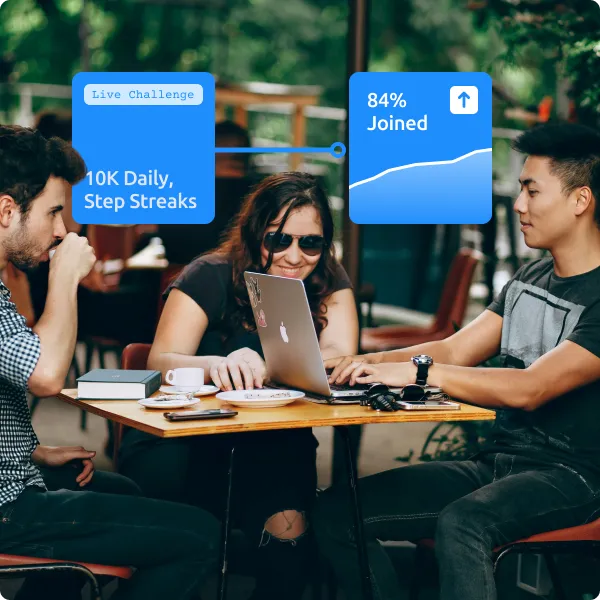













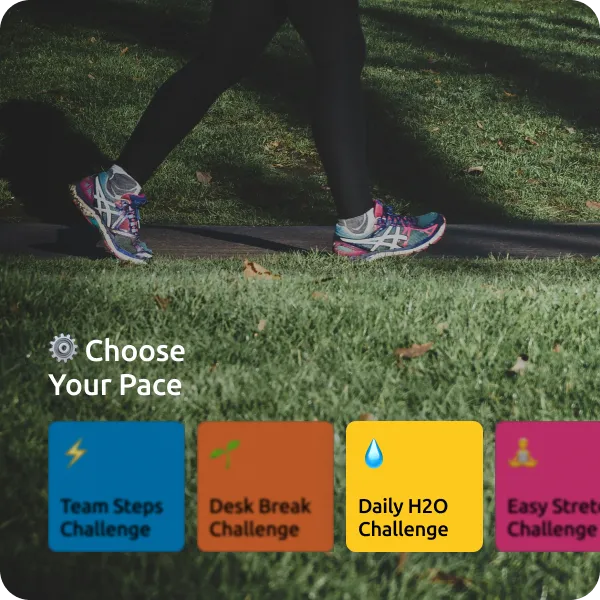
Wellbeing Challenges
Wellbeing Challenges
Wellbeing Challenges
Wellbeing Challenges
Wellbeing Challenges
Team-Powered Connection
Build Connections While Building Health
Team challenges with fair scoring create genuine cross-departmental connections - addressing your culture and engagement gaps while employees work toward shared wellness goals.
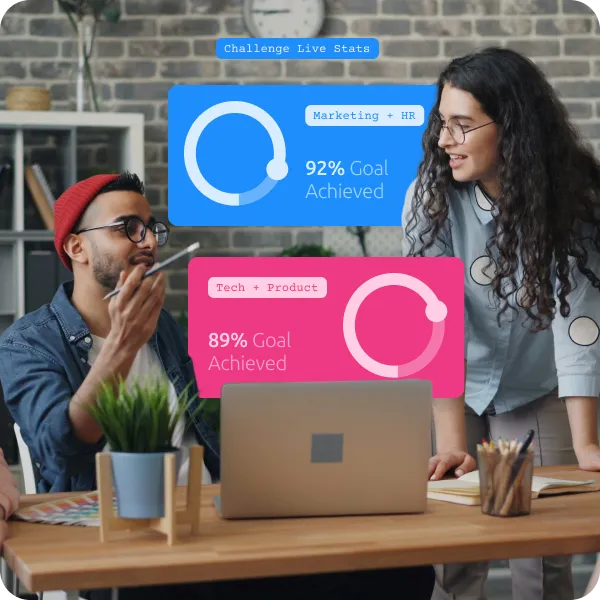
Employee-Led Challenges
Let Employees Create and Run Their Own Challenges
Employees launch peer-to-peer challenges year-round without HR involvement - multiplying program reach and sustaining momentum between your official initiatives.
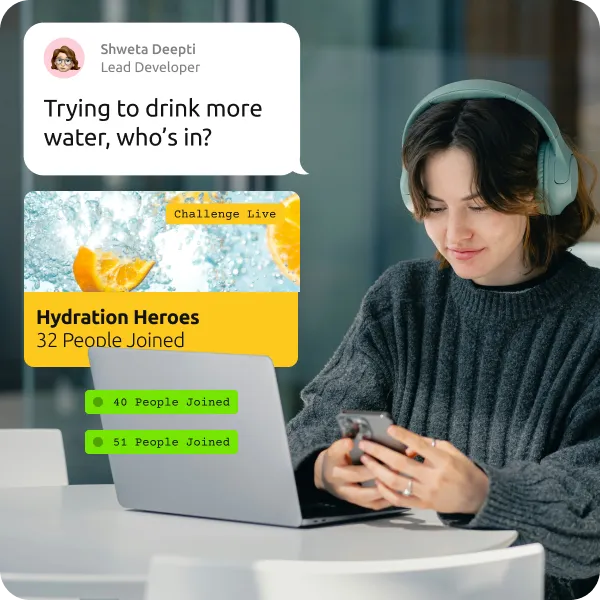
Universal Compatibility
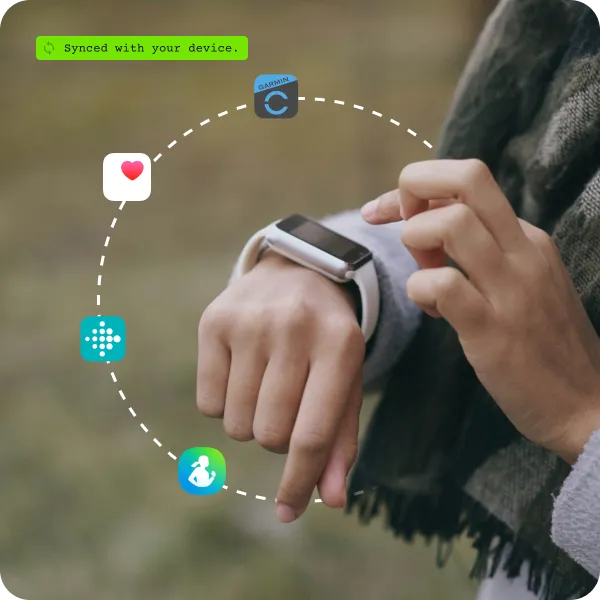
Works With Every Device Your Employees Already Own
Automatic syncing with Apple Health, Fitbit, Garmin, Samsung Health, and more - employees use devices they already own, eliminating the biggest obstacle to participation.
Educational Content
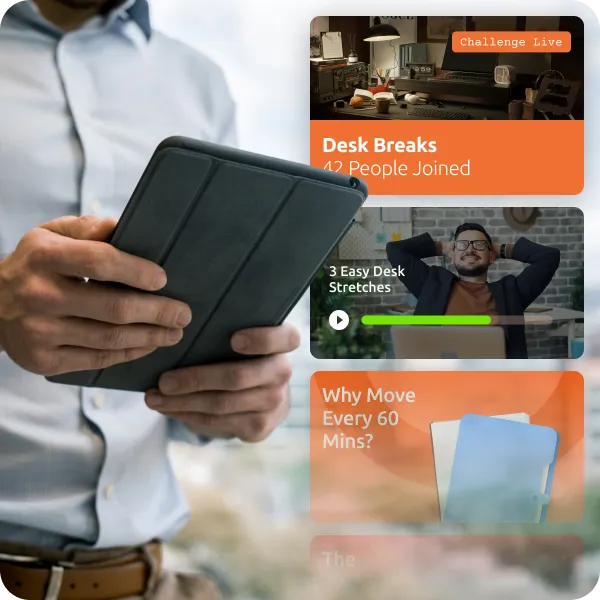
Add Articles, Videos, and Tips to Any Challenge
Challenges include embedded articles, videos, and actionable wellness content - so employees understand the "why" behind healthy behaviors and sustain changes after challenges end.
Fair Competition
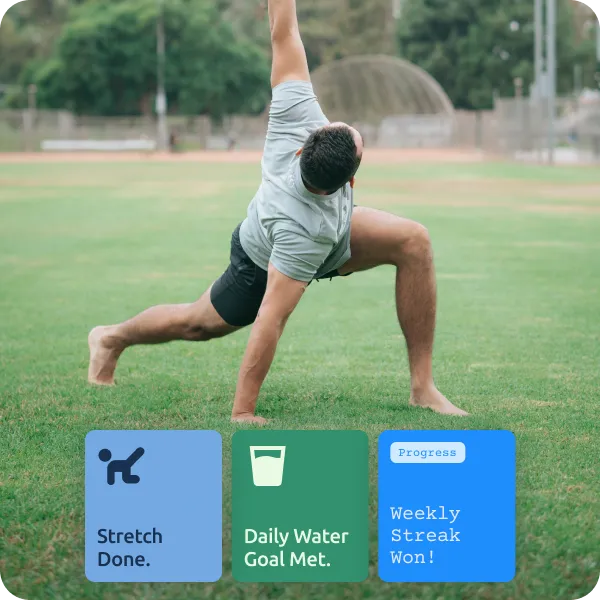
Built-In Fairness That Keeps Everyone Engaged
Customizable activity caps and personalized goals prevent ultra-performers from dominating - keeping beginners motivated and ensuring your challenges encourage rather than discourage the majority.
ROI Measurement
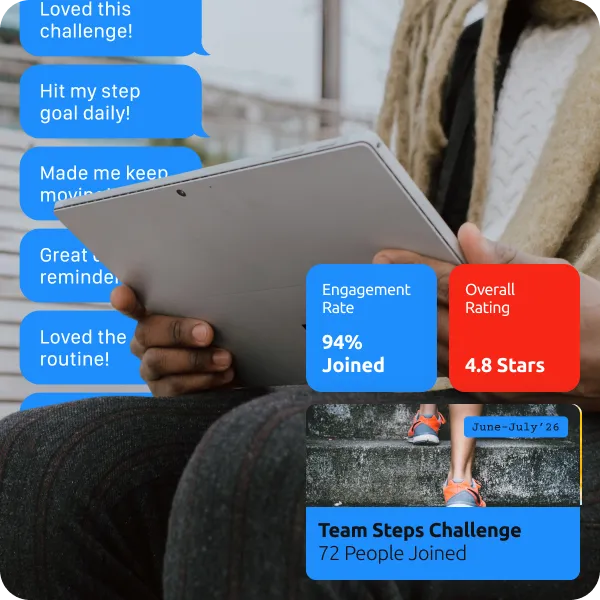
Collect Feedback Without the Manual Work
Required surveys automatically gather employee sentiment and program effectiveness data after every challenge - giving you continuous insights for improvement and concrete ROI metrics for leadership, with zero administrative lift.
Business Impact
The ROI of Wellness Challenges Done Right
Healthier employees. Higher engagement. Measurable impact on the metrics that matter most.
Inclusive design engages your entire workforce across all fitness levels - not just the already-healthy ones who typically participate.
Team challenges rebuild workplace relationships that predict retention - employees with strong work friendships are 7X more engaged and significantly less likely to leave, directly impacting your talent retention metrics.
Built-in surveys provide concrete program effectiveness data - turning budget defense conversations into strategic investment discussions.
Employee-created challenges sustain wellness momentum 365 days - extending program impact beyond official initiatives without increasing your administrative burden.





Integrations? We’re glad you asked.
Seamlessly connect with your HRMS and communications softwares. Customised to your specific use cases.
Talk to Sales


& more
Why choose Edenred?
At Edenred India, we blend innovation, trust, and impact to help organizations unlock value, one reward, one recognition, and one employee at a time
What is a health and wellness challenge and how does it work in the workplace?
Modern workplace wellness challenges have evolved beyond simple step-counting competitions. Today's most effective programs offer multiple challenge formats - from competitive leaderboards for fitness enthusiasts to gentle habit-tracking for wellness beginners - ensuring employees of all fitness levels find an entry point that feels achievable. This inclusive approach addresses the traditional problem where only the already-healthy 20% of employees participate, leaving the majority who could benefit most feeling excluded or intimidated.
The business value of wellness challenges extends far beyond fitness metrics. Organizations use these programs to rebuild workplace connections fractured by remote work, create cross-departmental collaboration opportunities, and demonstrate measurable wellness ROI to leadership. Edenred Wellbeing Challenges exemplifies this modern approach with seven distinct challenge modes - including Leaderboard, Team Leaderboard, Streak, Stick to It, Target, Virtual Race, and Daily Habit - each designed to accommodate different employee preferences and fitness levels. The platform's personalized goal-setting within admin-defined ranges ensures employees compete at appropriate levels, while built-in surveys capture the behavior change data and employee sentiment that proves program effectiveness to leadership, transforming wellness from quarterly events into year-round culture-building tools.
What makes a corporate wellness challenge successful in engaging employees?
Team-based elements prove particularly powerful for driving sustained engagement, especially in hybrid and remote work environments where spontaneous workplace connections have disappeared. When employees join teams with colleagues across departments or locations, wellness challenges create rare opportunities for informal relationship-building around shared, non-work goals. The positive peer accountability that emerges - not wanting to let teammates down - often sustains motivation more effectively than individual willpower, particularly during the mid-challenge period when initial enthusiasm typically wanes. Fair team scoring mechanisms that use averages rather than totals ensure groups of any size can compete equitably, maintaining engagement across diverse team compositions.
The most impactful corporate wellness challenges also extend beyond temporary competitions to drive lasting behavior change through embedded education and year-round engagement opportunities. Edenred Wellbeing Challenges addresses all these success factors through its inclusive design featuring seven challenge modes with personalized goals, team challenges with average-based scoring that prevents size advantages, and embedded wellness content - articles, videos, actionable tips - that helps employees understand the "why" behind healthy behaviors. The platform's unique employee-created challenge capability allows staff to launch peer-to-peer competitions up to five at a time, maintaining wellness momentum between official HR initiatives and transforming wellness from quarterly events into continuous culture. This combination of inclusive design, social connection, educational value, and sustained engagement opportunities delivers the 3X higher participation rates and measurable behavior change that justify organizational wellness investment.
How do you measure ROI on corporate wellness challenge programs?
Measuring wellness challenge ROI requires looking beyond simple participation rates to capture behavioral outcomes, employee sentiment, and connections to broader business metrics that leadership values. The most sophisticated wellness challenge platforms integrate pre and post-challenge surveys that automatically collect data on employee-reported health improvements, program satisfaction, perceived wellness support, and barriers to participation. These qualitative insights, combined with quantitative participation data - challenge completion rates, team engagement levels, user-created challenge frequency - provide a comprehensive view of program effectiveness that justifies wellness investment to C-suite stakeholders who demand evidence-based decision making.
Behavioral metrics offer concrete evidence of wellness impact that transcends vanity metrics. Organizations should track not just how many employees joined a single challenge, but patterns of sustained engagement: Are employees participating in multiple challenges throughout the year? Are they creating peer-led challenges between official programs? Are team formations strengthening cross-departmental relationships that improve collaboration on work projects? Is there correlation between challenge participation and reduced absenteeism or improved engagement survey scores? These indicators reveal whether wellness initiatives are becoming embedded in organizational culture or remaining isolated HR events with minimal lasting impact.
The most compelling ROI case connects wellness challenge engagement to business outcomes leadership already monitors closely. Organizations with mature wellness programs can correlate challenge participation data with employee retention rates, healthcare cost trends, productivity metrics, and engagement scores. Edenred Wellbeing Challenges provides the measurement infrastructure to build this ROI case through required surveys that capture employee sentiment and behavior change after every challenge, comprehensive participation analytics showing engagement patterns across demographics and departments, and automated reporting that eliminates manual data compilation. The platform's survey data - non-anonymous to allow for follow-up and trend analysis - gives wellness leaders the evidence to position wellness as a strategic retention and engagement tool rather than a benefits line item. When challenges demonstrably contribute to retention - replacing an employee costs 50-200% of their salary - and engagement, the investment case becomes self-evident, transforming budget defense conversations into strategic expansion discussions.
Benefits of wellness challenges in the workplace
Improved Employee Health and Reduced Healthcare Costs
Stronger Employee Engagement, Connection, and Retention
Demonstrable ROI and Strategic Positioning for HR
What are the biggest challenges in implementing workplace wellness challenges?
The most persistent challenge in workplace wellness programs is the participation paradox: only the already-healthy employees engage while the 80% who could benefit most - those with elevated health risks, sedentary lifestyles, or chronic conditions - opt out before even trying. This inverse targeting occurs because traditional wellness challenges are designed with competitive, one-size-fits-all structures that intimidate beginners and exclude employees who don't see themselves as "fitness people." When challenges celebrate absolute performance rather than personal progress, they inadvertently create two classes of participants: the fitness elite who dominate leaderboards and everyone else who feels wellness "isn't for them," reinforcing health inequities rather than addressing them.
Administrative burden represents another significant implementation barrier that prevents wellness coordinators from moving beyond operational execution to strategic program improvement. Traditional wellness challenges require HR teams to manually track participation, sync device data, calculate scores, manage spreadsheets, troubleshoot technical issues, and compile reports - consuming hours that should be spent analyzing program effectiveness and planning improvements. This operational trap means wellness leaders are executing programs rather than optimizing them, unable to iterate based on employee feedback or demonstrate ROI to leadership because they're buried in logistics. Without automation and built-in analytics, wellness programs remain resource-intensive tactical initiatives rather than strategic culture-building tools.
The sustainability challenge - creating lasting behavior change rather than temporary activity spikes - represents perhaps the most critical implementation obstacle. Most organizations run quarterly or annual wellness challenges that generate initial enthusiasm followed by complete drop-off, with employees reverting to baseline behaviors as soon as challenges end. Edenred Wellbeing Challenges directly addresses these three implementation barriers through inclusive design featuring customizable activity caps and personalized goals that engage all fitness levels (driving 3X higher participation), automated syncing and scoring that reduces administrative time by 75%, and employee-created challenge capabilities that sustain wellness momentum year-round without HR intervention. The platform's embedded educational content - articles, videos, wellness tips integrated directly into challenges - helps employees understand sustainable practices beyond temporary competition, while Daily Habit challenges specifically target long-term behavior formation. This comprehensive approach transforms wellness challenges from expensive quarterly events with minimal lasting impact into strategic culture-building tools that deliver measurable business outcomes.
How do I start a wellness challenge at work?
Begin with clarity on what you're building - not just a challenge, but a culture shift. Define your goal: healthier employees, stronger connections, measurable engagement, or budget-defending ROI.
Survey your people to understand where they actually are, not where you wish they were. The fatal mistake? Designing for your marathon runners while your majority sits this out. Winning challenges offer multiple entry points - competitive leaderboards for the driven, team formats for the connection-seekers, gentle habit-tracking for the "I'm not a gym person" crowd.
Choose 21-30 days (the habit-formation sweet spot), embrace personalized goals that let everyone win at their level, and pick technology wisely: spreadsheets drain your time, consumer apps lack what you need, purpose-built platforms do the heavy lifting for you.
Promote 2-3 weeks early across every channel - make joining feel inevitable, not optional. Once live, feed the energy: regular updates, milestone celebrations, fresh content that gives people reasons to stay engaged. When it's over, celebrate loudly and survey honestly - that feedback becomes your ROI proof and your roadmap forward.
Edenred Wellbeing Challenges turns this vision into reality: seven challenge types that welcome everyone, automation that reclaims 75% of your time, engagement tools that build genuine connection, and built-in measurement that hands you the data leadership demands. First-time coordinators don't just run challenges - they ignite movements, achieving 3X the participation others settle for.
What incentives work best for wellness challenge participation?
The most effective wellness challenge incentives balance intrinsic and extrinsic motivation, recognizing that sustainable engagement comes from internal drivers like social connection, personal achievement, and autonomy rather than purely external rewards. Research consistently shows that challenges emphasizing progress recognition, team celebration, and personal goal achievement drive longer-term participation than those relying solely on prizes or financial incentives. Employees motivated by genuine wellness improvement and social belonging continue engaging after incentives end, while those participating only for rewards typically drop off immediately when incentives disappear.
That said, thoughtful extrinsic incentives can effectively jumpstart participation and signal organizational commitment to wellness. The most successful approaches use tiered incentives that reward participation and effort rather than just performance - ensuring beginners and advanced participants alike can earn recognition. Popular options include wellness program points redeemable for health-related products, charitable donations made in participants' names, extra paid time off, premium parking spots, or company swag. The key is keeping incentives modest enough to avoid "gaming the system" behaviors while meaningful enough to demonstrate genuine organizational investment in employee wellbeing.
Edenred Wellbeing Challenges is designed to maximize intrinsic motivation through features that make participation inherently rewarding: team-based challenges create social accountability and connection that employees value beyond prizes, personalized goals ensure everyone experiences achievement regardless of fitness level, and embedded educational content helps employees understand wellness benefits beyond external rewards. The platform's social features - likes, comments, achievement celebrations - provide the recognition and belonging that research shows drives sustained engagement more effectively than monetary incentives alone. For organizations that do offer extrinsic rewards, Wellbeing integrates seamlessly with points-based wellness programs and provides the completion tracking and verification data needed to administer incentives fairly. Organizations report that combining the platform's intrinsic motivation design with modest extrinsic incentives creates the optimal participation mix - strong initial engagement that transitions into sustained, self-motivated wellness culture.
Frequently Asked Questions


