
SmartHub Analytics
Analytics that Unlock the Business Impact Hidden in Your Engagement Data
SmartHub Analytics connects every employee touchpoint to measurable business outcomes — proving how engagement drives retention, productivity, and profitability across your organization.
Talk to Sales
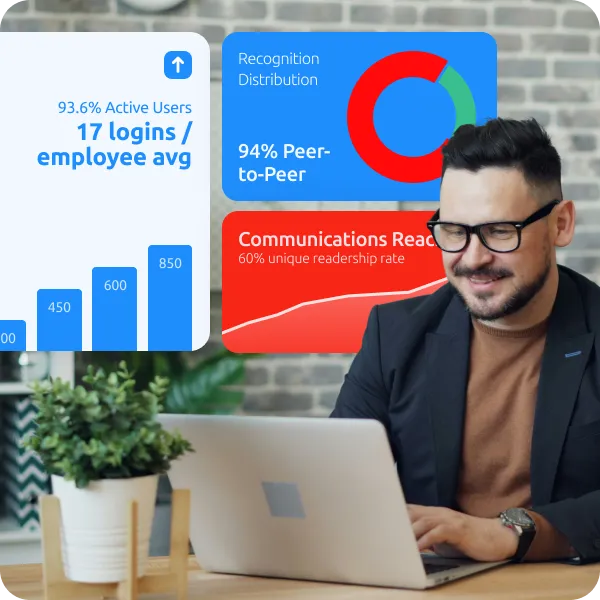













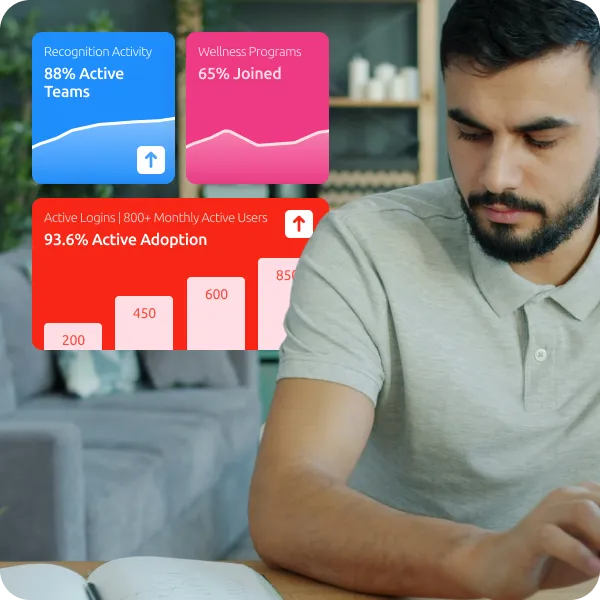
SmartHub Analytics
SmartHub Analytics
SmartHub Analytics
SmartHub Analytics
SmartHub Analytics
Real-Time Performance Tracking
Watch Engagement Move Your Business Metrics Live
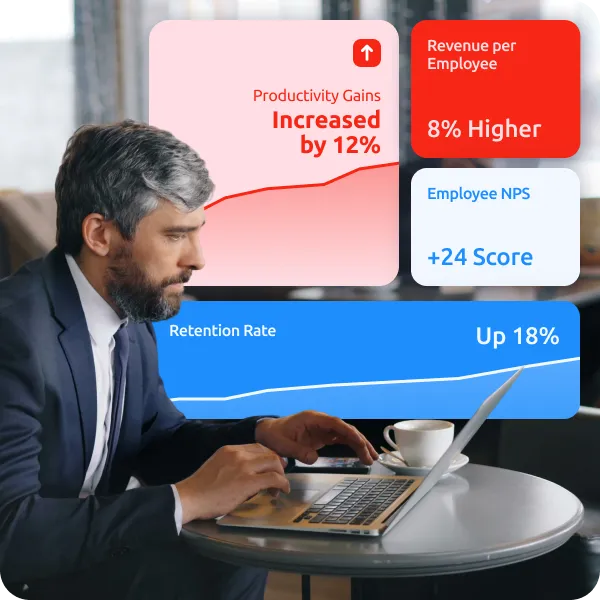
Connect engagement activities directly to retention rates, employee NPS, productivity gains, and revenue per employee — proving ROI in real time, not quarterly.
Predictive Retention Intelligence
Identify Flight Risks Before Your Best Talent Starts Job Searching
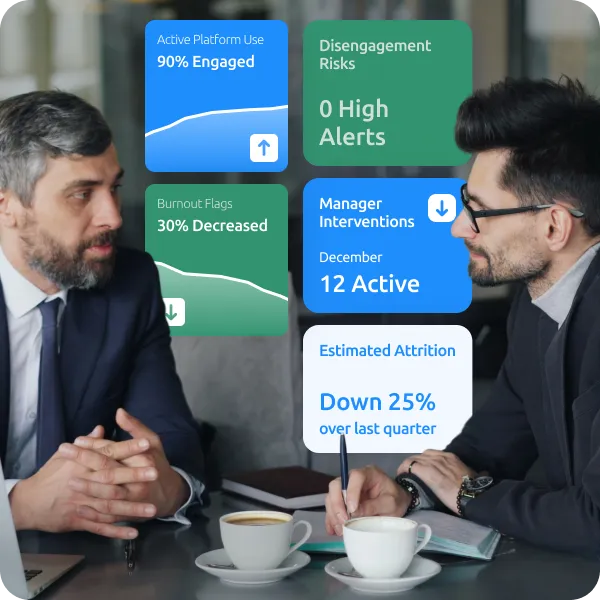
Detect early warning signals like declining engagement scores, reduced platform activity, and negative sentiment shifts, and equip managers with insights to intervene before your best talent walks out the door.
Adoption & Utilization Metrics
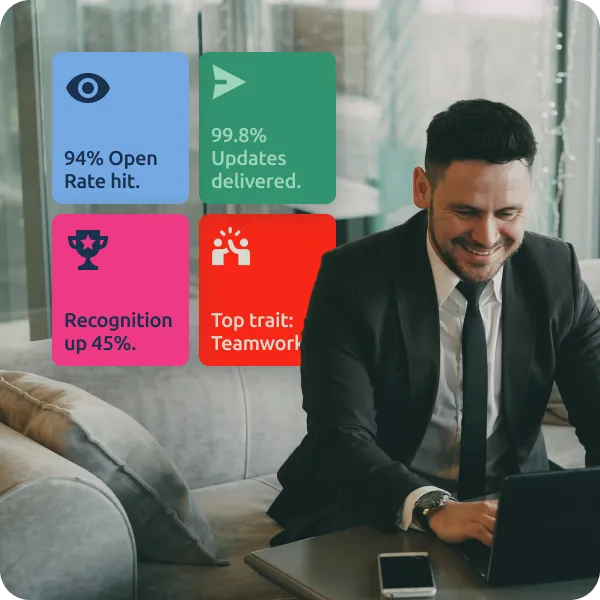
Track Recognition Patterns, Employee Response, Communication Reach and More
Monitor recognition activity, communication open rates, read rates, and engagement trends through centralized dashboards — turning recognition and communication data into actionable insights that optimize messaging strategy and cultural impact.
Wellness Impact Measurement
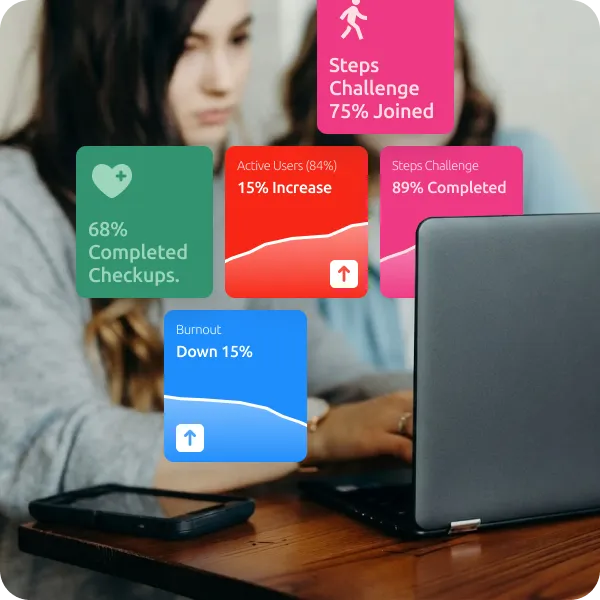
Measure Wellness Adoption, Challenge Participation, and Health Improvement
Track wellness program participation, health check completion rates, mental wellbeing engagement, step challenge activity, and absenteeism reduction — connecting health data to productivity, resilience, and reduced burnout across your organization.
Flexible Reporting Views
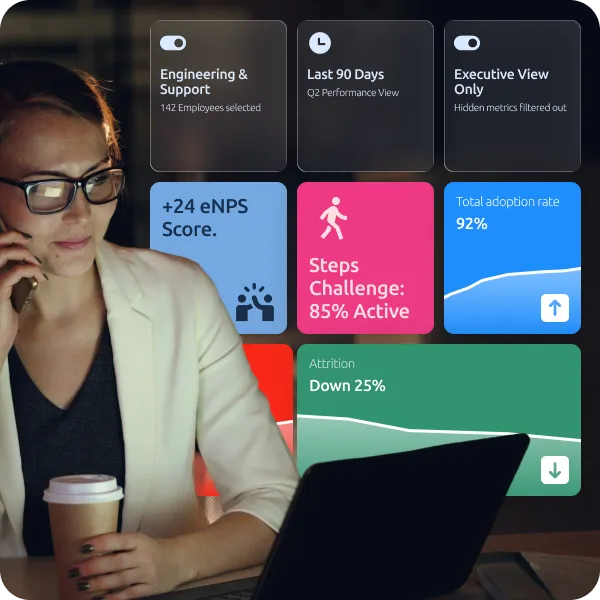
One Dashboard with Infinite Views. Filter and Share Insights for Every Stakeholder
Filter analytics by team, metric, or timeframe to surface the insights that matter most, then share tailored views with stakeholders — connecting engagement investment to retention, productivity, and revenue outcomes in formats leadership understands.
Business Impact
Measurable Impact That Transforms HR From Cost Center to Growth Driver
Track adoption, engagement, and utilization across all systems through one dashboard — transforming HR from cost center to strategic function with data that demonstrates clear connections between experience investments and business outcomes.
Organizations using Edenred's integrated analytics see dramatic improvements in employee Net Promoter Scores, signaling stronger engagement and loyalty.
Connect engagement initiatives to retention outcomes and reduce turnover by identifying and addressing disengagement before employees leave.
Eliminate data silos and gain complete visibility into how recognition, wellness, communications, and rewards impact business performance.
Transform engagement from an HR activity into a measurable driver of business performance with clear connections to productivity, profitability, and retention.





Integrations? We’re glad you asked.
Seamlessly connect with your HRMS and communications softwares. Customised to your specific use cases.
Talk to Sales


& more
Why choose Edenred?
At Edenred India, we blend innovation, trust, and impact to help organizations unlock value, one reward, one recognition, and one employee at a time
What is employee engagement analytics and why does it matter for business performance?
The strategic importance lies in transformation: engagement analytics converts HR from a cost center running programs into a growth driver delivering measurable ROI. Organizations using integrated engagement analytics can prove that their people initiatives directly impact profitability, with research showing engaged teams deliver 23% higher profitability and 18% higher productivity. When HR leaders can demonstrate that a 22-point improvement in employee NPS correlates with 18% attrition reduction, engagement becomes a boardroom conversation about business performance, not just an HR activity.
How does SmartHub Analytics differ from traditional HR reporting tools?
The fundamental difference is outcome orientation versus activity tracking. While traditional tools tell you how many recognition messages were sent or surveys completed, SmartHub connects these activities to business outcomes: how recognition frequency impacts retention in specific departments, how wellness participation correlates with productivity gains, or how communication engagement predicts employee NPS changes. This transforms analytics from descriptive reporting into predictive intelligence.
SmartHub also provides real-time visibility rather than quarterly reports. HR leaders can monitor engagement's impact on business metrics continuously, identifying flight risks before they become turnover and optimizing programs based on what's actually driving results, not what they hope is working.
Can engagement analytics predict employee attrition and retention issues?
Yes, when implemented correctly. Engagement analytics leverages continuous data streams from multiple touchpoints — employee NPS tracking, sentiment analysis from surveys, recognition patterns, wellness participation, and communication engagement — to identify early warning signals that precede attrition.
The key is frequency and integration. Traditional annual engagement surveys provide one data point per year, making prediction impossible. SmartHub Analytics captures daily engagement signals across the entire employee experience, creating a comprehensive engagement profile for each employee and team. When an employee's recognition frequency drops, wellness participation declines, and survey sentiment turns negative simultaneously, these combined signals predict flight risk with high accuracy.
Organizations using integrated engagement analytics report 18% attrition reduction because they can intervene proactively. Instead of discovering disengagement during exit interviews, HR leaders identify struggling teams or individuals in real time and deploy targeted interventions — additional recognition, wellness support, manager coaching — before employees start job searching. This shifts HR from reactive damage control to proactive retention strategy.
How do you connect engagement data to business metrics?
Connecting engagement to business metrics requires three elements: unified data integration, outcome mapping, and longitudinal analysis. SmartHub Analytics integrates with enterprise HRIS platforms (SAP, Oracle, Darwinbox, Keka) to combine engagement data with business performance data, creating a complete picture of how people initiatives impact organizational outcomes.
Outcome mapping establishes correlations between engagement activities and business metrics. For example, tracking how departments with higher recognition frequency perform on revenue per employee, or how teams with strong wellness participation rates compare on productivity metrics and sick day utilization. Over time, these correlations reveal causal patterns: that consistent recognition drives 18% higher productivity, or that comprehensive wellness programs reduce sick days while improving output.
The strategic value emerges when HR can present data-driven narratives to leadership: "Our investment in engagement programs delivered a 22-point eNPS improvement, which correlates with 18% attrition reduction, saving the organization X in replacement costs while maintaining productivity." This transforms engagement from soft HR initiative into hard business strategy, making people programs as measurable as sales and operations initiatives.
How do engagement analytics help reduce the SaaS fragmentation problem in HR technology?
SaaS fragmentation is one of the most pressing challenges facing HR leaders today - organizations typically manage engagement through multiple disconnected vendors for recognition, wellness, surveys, and communications. This creates data silos where each platform tracks its own metrics in isolation, making it impossible to understand the complete engagement picture or prove business impact.
Engagement analytics platforms like SmartHub solve this by operating as a unified intelligence layer that consolidates data from all engagement touchpoints into one system. Instead of logging into five different dashboards to see recognition activity, wellness participation, survey responses, and communication engagement separately, HR leaders gain consolidated visibility across all initiatives. This integration reveals patterns invisible in fragmented systems - for example, how employees who receive regular recognition also show higher wellness program participation and more positive survey sentiment.
The strategic advantage is transformative: unified analytics eliminate vendor sprawl, reduce administrative burden, and most importantly, enable HR to connect engagement spend directly to business outcomes like retention, productivity, and revenue per employee. When all engagement data flows through one analytics platform, HR can finally answer the CFO's question: "What's the ROI on our engagement investment?"
What role does employee NPS tracking play in measuring engagement effectiveness?
Employee Net Promoter Score (eNPS) has emerged as a critical metric for measuring engagement effectiveness because it predicts both retention and business performance. Unlike traditional engagement surveys that measure satisfaction retrospectively, eNPS asks the forward-looking question: "How likely are you to recommend this organization as a place to work?" This transforms engagement measurement from activity tracking to outcome prediction.
Continuous eNPS tracking through engagement analytics platforms reveals patterns that annual surveys miss entirely. When eNPS scores decline in specific departments or teams, it signals disengagement before it manifests as attrition. Organizations using integrated engagement analytics report +22 point eNPS improvements by identifying these early warning signals and deploying targeted interventions - increased recognition, wellness support, or manager coaching - before employees start job searching.
The business case is compelling: improved eNPS correlates directly with reduced attrition and higher productivity. Organizations that track eNPS continuously alongside engagement activities can prove causation, not just correlation - showing leadership exactly which initiatives drive the scores that predict retention. This elevates eNPS from an HR metric to a business performance indicator that belongs in boardroom conversations alongside revenue and profitability.
Why is real-time engagement analytics more valuable than annual engagement surveys?
Annual engagement surveys provide one data point per year, creating a 365-day blind spot where disengagement festers undetected until it manifests as attrition. By the time HR discovers problems in annual survey results, the damage is done - top performers have already started job searching, team dynamics have deteriorated, and productivity has declined. This reactive approach makes engagement measurement a post-mortem exercise rather than a strategic tool.
Real-time engagement analytics fundamentally changes this dynamic by capturing continuous signals from daily employee interactions - recognition patterns, wellness participation, communication engagement, and pulse survey sentiment. When an employee's engagement profile shows declining recognition frequency, dropping wellness participation, and increasingly negative survey responses simultaneously, these combined signals predict flight risk weeks or months before annual surveys would detect the problem. This enables proactive intervention rather than reactive damage control.
The business impact is substantial: organizations using real-time engagement analytics report 18% attrition reduction because they can identify and address disengagement before employees leave.
Real-time visibility also enables rapid program optimization - if a new recognition initiative isn't driving adoption or improving sentiment within the first month, HR can adjust immediately rather than waiting a year to discover the program failed. This agility transforms engagement from an annual HR event into a continuous business performance driver.
How do engagement analytics help organizations move from measuring activity to measuring outcomes?
The fundamental problem with traditional engagement measurement is its focus on activity metrics - how many recognition messages were sent, how many employees attended events, how many rewards were redeemed. These metrics show that programs are running, but they don't answer the strategic question: "Is engagement improving business performance?" This activity-versus-outcome gap is why engagement initiatives often lose leadership support despite widespread HR effort.
Engagement analytics platforms shift the focus by connecting every activity to business outcomes. Instead of reporting "5,000 recognition messages sent this quarter," analytics reveal "departments with consistent recognition show 18% higher productivity and 22-point eNPS improvement." Instead of "70% wellness program participation," analytics demonstrate "teams with high wellness engagement show 15% fewer sick days and maintained productivity during high-stress periods." This transformation makes engagement measurable using the same outcome-focused language that leadership applies to sales, operations, and finance.
The strategic advantage is profound: when HR can prove that engagement directly drives retention, productivity, revenue per employee, and profitability, engagement becomes a boardroom conversation about business performance rather than an HR activity report. Organizations using outcome-focused analytics report that engagement investment receives the same strategic priority as technology infrastructure or market expansion - because leadership can see engagement's direct contribution to business results. This elevates HR from cost center running programs to growth driver delivering measurable ROI.
Frequently Asked Questions


